
India's strikes on Pakistan damaged runways and structures across at least six airfields, according to a visual analysis by The Washington Post, which experts said were the most significant attacks of their kind in decades of simmering conflict between the two nations.

Trading activity of foreign investors and global trends will be the major driving factors for the equity markets in a holiday-shortened week ahead, according to analysts. Leading stock exchanges BSE and NSE have declared a trading holiday on November 20 for assembly elections in Maharashtra. Elections to the 288-member state legislative assembly will be held on November 20, and votes will be counted on November 23.

'For 40 years, India valued only technical skills. IITs, coding -- that became everything.' 'Soft skills were sidelined. But those are the skills that will keep you employable now, not technical skills.'

Quarterly earnings from corporates, global trends, and trading activity of foreign investors will guide market sentiment this week, analysts said, adding that benchmark indices may face volatile trends. "The upcoming release of Q2 results will be closely watched, providing insights into corporate performance. "Meanwhile, the escalating tensions between Israel and Iran introduce a significant geopolitical risk, potentially leading to increased oil prices and market volatility.

Real estate developers are hoping that the slew of tax concessions announced in Union Budget 2025, set to take effect this financial year, will spur demand for affordable and mid-segment housing, even as the broader housing market shows signs of fatigue.

The rupee extended its losses and slipped 12 paise to 77.74 against the US dollar in early trade on Thursday, weighed down by a muted trend in domestic equities and unabated foreign fund outflows. At the interbank foreign exchange, the rupee opened at 77.72 against the American dollar, then lost ground to quote at 77.74, registering a fall of 12 paise from the last close. On Wednesday, the rupee declined by 1?7 paise to close at its fresh lifetime low of 77.6?1 against the US dollar.

Gold prices tumbled by Rs 3,350 to Rs 72,300 per 10 grams in the local market in New Delhi on Tuesday amid subdued demand by jewellers after the government announced the customs duty cut on the yellow metal and silver to 6 per cent.

The restaurant chains are riding the Hallyu wave -- a phenomenon about the growing global prominence of South Korean pop culture.

The sharp pullback in mid and smallcap stocks signals a cooling-off period in segments that previously attracted considerable investor interest.

Wholesale price inflation moderated to 2.31 per cent in January due to the decline in prices of food items especially vegetables, government data released on Friday showed. The Wholesale Price Index (WPI) based inflation was 2.37 per cent in December 2024. It was 0.33 per cent in January 2024.

An escalation in the already simmering tensions between North and South Korea, China and Taiwan, and Russia and Ukraine could prove to be a bigger worry for the markets over the next few months rather than central bank policy action, said analysts. The markets, they said, are still not fully factoring in this possibility. "The conflict between Iran and Saudi Arabia is another geopolitical worry.

Multi-asset allocation funds emerged as the most popular option for MFs as they provided the needed flexibility.

The equity benchmark indices posted their strongest weekly gains in years, driven by bargain hunting and optimism over a reversal in foreign portfolio investor (FPI) outflows. The Sensex rose 558 points, or 0.7 per cent, on Friday to close at 76,906, while the Nifty 50 gained 160 points to end at 23,350. Over the past five sessions, both indices advanced around 4.3 per cent - marking the Sensex's best weekly performance since July 22, 2022, and the Nifty 50's strongest rally since February 5, 2021.

Investors shunned shares of oil marketing companies (OMCs) on Friday as they feared that the government's decision to cut retail prices of petrol and diesel could hurt the companies' profit margins in the near term. On Thursday, the government announced that OMCs will reduce pump prices of petrol and diesel after a record 22 months, making them cheaper by Rs 2 per litre in the national capital. The changes were effective from Friday.

Dalal Street investors were a poorer lot on Monday as their wealth eroded sharply by Rs 14 lakh crore following a sharp decline in benchmark indices amid a global market meltdown due to recession fears. The 30-share BSE Sensex tumbled 2,226.79 points or 2.95 per cent to settle at 73,137.90. Intra-day, the benchmark slumped 3,939.68 points or 5.22 per cent to 71,425.01.

For the first time, the rupee declined to the low level of 80 against the US dollar in intra-day spot trading on Monday before ending the session 16 paise lower at 79.98 amid a surge in crude oil prices and unrelenting foreign fund outflows. At the interbank forex market, the local unit opened at 79.76 against the greenback but lost ground to touch the psychological low mark of 80 against the American currency. The local unit clawed back some lost ground and closed at 79.98, registering a fall of 16 paise over its previous close.

The outcome of the Union Budget, quarterly earnings from corporates and global trends are the major factors to drive stock market sentiments this week, analysts said. Besides, the trading activity of foreign investors, the rupee-dollar trend and the movement of global oil benchmark Brent crude are also crucial aspects to watch out for.

Stock markets are expected to remain under pressure this week due to the overhang of US presidential polls and uncertainty over global growth due to resurging cases of coronavirus, according to analysts.

After a strong run in the midcap and smallcap indices, which surged 46 per cent and 43 per cent, respectively, on the National Stock Exchange (NSE) during Samvat 2080, analysts suggest that the rally in these segments may pause to catch its breath in Samvat 2081.

Auto Expo 2023 may not trigger a fresh rally in automobile stocks, say analysts, as this year's edition lacks participation from major listed players. It is also owing to the focus on electric vehicles (EVs), a segment where four-wheelers have minuscule market share. "In the passenger vehicles (PV) segment, Maruti Suzuki India and Tata Motors are the only listed players.

Global fund managers witnessed one of their largest-ever declines in assets under custody (AUC) during the ongoing correction in the Indian markets, as stocks came under pressure from foreign outflows and the weakening rupee.

Equity markets will take cues from global trends and trading activity of foreign investors, while in the latter part of the week the first quarter earnings from IT majors TCS and HCL Technologies would guide investor sentiments, analysts said. Markets may consolidate after the record rally last week, experts added. "On the domestic front, the Q1 earnings season begins this week. Key companies such as TCS and HCL Technologies will release their earnings on July 11 and 12, 2024, respectively.

Gold, a safe-haven bet, is likely to continue its record-smashing journey in the New Year, rising to Rs 85,000 per 10 grams and even Rs 90,000 level in domestic markets if geopolitical tensions and global economic uncertainties continue.

The ongoing fourth quarter earnings season, global factors and macroeconomic data would guide the trends in the equity markets this week, analysts said. Markets would also take cues from trading activity of foreign investors, rupee-dollar trend and movement of global oil benchmark Brent crude. "Domestically, the next batch of Q4 earnings reports will drive stock-specific movements, Hero MotoCorp, Larsen & Toubro, BPCL, State Bank of India, Eicher Motors and Tata Motors are some of the big names in the list and the next phase of voting," said Pravesh Gour, senior technical analyst, Swastika Investmart Ltd.

The Reserve Bank of India's (RBI's) interest rate decision, West Asia conflict and trading activity of foreign investors are the key factors that will dictate investors' sentiment in the market this week, analysts said. Moreover, quarterly earnings from IT bellwether TCS, domestic macroeconomic data and movement in global oil benchmark Brent crude would also guide trends in the market. Worsening tensions in the Middle East and foreign fund outflows were the major culprits behind the equity markets sharp fall last week.

'As the markets are expected to remain jittery in the near term, we advise investors to use this opportunity to enter quality largecaps from a long-term perspective.'
If Hindenburg or its partner do not join the investigation, then Sebi may pass an ex-parte order against it, which may be enforced as a foreign award in US courts.

After declining to a three-year low in FY24, the private sector investment is expected to fall further in the current financial year, India Ratings said in a research note.. The investments in the private sector are likely to plummet to below 11 per cent of the GDP in FY25, based on the trends from the latest national accounts data and company fillings, it noted.

As regards mid-caps and small-caps, analysts suggest investors buy only those stocks of those companies where there is earnings visibility for at least a few quarters and where the valuations have become reasonable.

'As more and more work becomes automated and a range of lower-level and higher-level tasks are replaced by AI, the need for a classic command-and-control pyramid structure goes away.'

After lagging behind benchmarks and broader indices over the past five years, real estate investment trusts (Reits) have outperformed them since the start of 2024. The four listed Reits have posted an average return of 16 per cent year-to-date, compared to 9.9 per cent for the S&P BSE Sensex and 11 per cent for the National Stock Exchange Nifty.

The index could be vulnerable to a bigger fall given the present market dynamics.
The last batch of quarterly earnings, global trends and trading activity of foreign investors will guide the equity market movement in a holiday-shortened week ahead, analysts said. Volatility may continue amid investors' cautious approach in the election season. Markets will remain closed on Monday due to the fifth phase of the Lok Sabha elections in Mumbai.
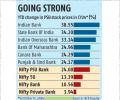
Stock Market News today, PSU banks: The year 2024 was a roller-coaster ride for Indian stock markets, marked by volatility driven by the Lok Sabha elections, Union Budget 2024, a slowdown in corporate earnings, and sticky inflation. Geopolitical tensions - particularly between Israel and Iran in West Asia - along with various stimulus announcements by China and yen carry trade rocked the equity markets throughout the year.

Shares of eight of the ten listed firms of the Adani Group ended with gains on Tuesday after taking a beating in recent sessions. Adani Enterprises stock jumped 14.22 per cent to settle at Rs 1,364.05 on the BSE. During the day, it rallied 19 per cent to Rs 1,421.95.

Equity mutual funds witnessed an inflow of Rs 35,943 crore in November, marking a drop of 14 per cent on a month-on-month basis, amid heightened volatility in stock markets driven by various macroeconomic factors, geopolitical events and US election results. Despite this, it marked the 45th consecutive month of net inflows into equity-oriented funds, reflecting the growing popularity of mutual funds among investors, according to data from the Association of Mutual Funds in India (AMFI) released on Tuesday.

Among the 11 equity sub-categories, thematic funds received the highest net inflows at Rs 9,017 crore, followed by smallcap funds at Rs 5,721 crore and flexicap funds at Rs 5,698 crore.

Macroeconomic data announcements, the last batch of Q1 earnings and global trends are the major factors that would influence trading sentiments in the equity market in a holiday-shortened week ahead, analysts said. Besides, trading activity of foreign investors would also be a crucial factor in dictating movement in the market. Equity markets would remain closed on Thursday for Independence Day.

Analysts suggest investors remain in a wait-and-watch mode and not jump in to buy stocks across-the-board.

Major Indian carmakers are preparing for sluggish domestic PV sales growth of just 1-2 per cent in FY26.
